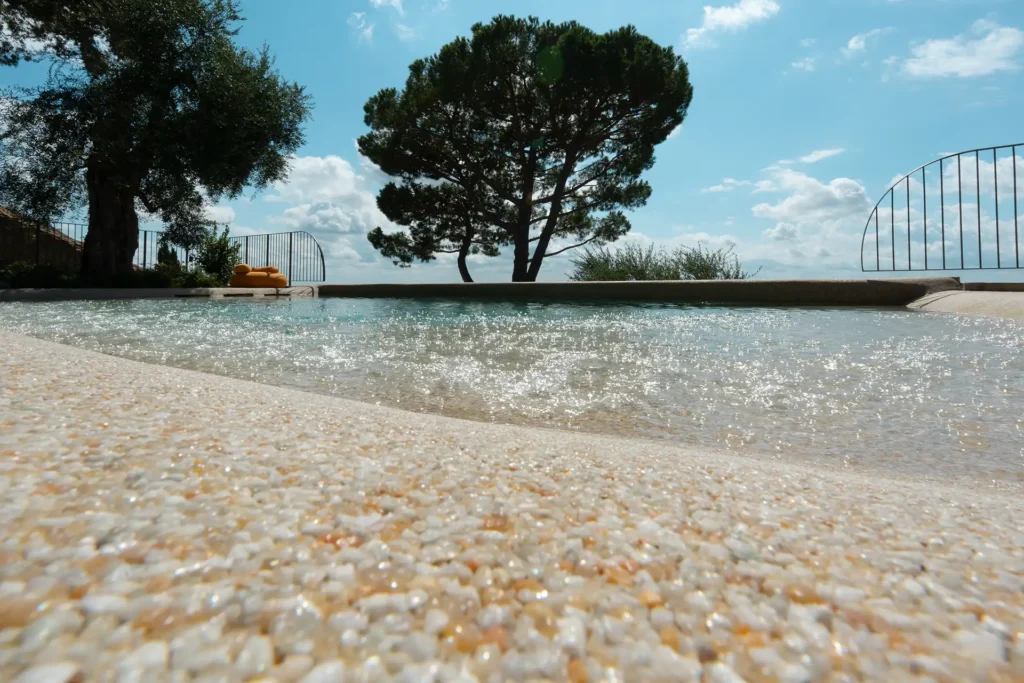
Surrounded by greenery, protected by ancient walls and far from the noise of traffic, La Monastica is a place where calm and serenity can be rediscovered.
Nature helps relieve stress
We have become so accustomed to background noise that we barely notice it anymore. Yet it takes only a short stay at La Monastica to realise how profoundly restorative the silence of nature can be, and how essential it is in easing mental tension.
We have become dependent on noise
Noise has become the permanent soundtrack of our lives. Cars, sirens, televisions, notifications, overlapping conversations, construction sites and music playing in shops surround us every day. Even when we believe we are in silence, our brains continue to process an enormous amount of auditory information. As a result, we no longer perceive noise as something unusual. We accept it as normal. We adapt to it, or at least we think we do. In reality, our nervous system never truly adjusts. Every unexpected sound requires evaluation, monitoring and response. Even without our awareness, the brain remains active, alert and ready to react, consuming valuable mental energy.
This is one of the reasons why so many people reach the end of the day with a feeling that is difficult to define. It is more than simple tiredness. It is cognitive fatigue, making it harder to concentrate, make decisions, remember things and even relax. Sleep becomes lighter, mornings begin with exhaustion, and the mind seems permanently occupied. Noise does far more than disturb our hearing. It changes the way the brain allocates its resources.


Why the brain becomes tired
Environmental psychology explains this phenomenon through the concept of directed attention: the type of concentration we rely on when working, reading, driving through traffic or solving complex problems. Every time we ignore unwanted noise, filter out distractions or redirect our attention, we consume part of this limited cognitive resource. As the day progresses, this mechanism becomes increasingly fatigued. At the same time, cortisol, the body’s primary stress hormone, rises. The result is an apparent paradox: we feel mentally exhausted, yet our bodies continue to behave as though they must remain on constant alert.
This is one reason why many people struggle to fall asleep despite feeling profoundly tired. The body longs for rest, while the brain finds it difficult to leave behind the state of continuous vigilance it has maintained throughout the day.
Nature speaks the language of our biology
Here we encounter one of the most fascinating concepts in evolutionary psychology: biophilia.
Psychologist Erich Fromm first recognised this human inclination, while biologist Edward O. Wilson later developed it into a scientific theory. Its premise is both simple and profound: human beings possess an innate tendency to seek contact with nature because it is within natural environments that our species evolved over millions of years. The brain unconsciously interprets greenery, water, trees and biodiversity as signals of safety. This is not merely a cultural preference or an aesthetic appreciation. It is deeply rooted in our biology.
This explains why the gentle movement of leaves, birdsong, rolling hills or drifting clouds affect us so differently from the artificial sounds and relentless stimulation of urban life.
Nature does not demand our attention. It captures it gently. Psychologists describe this as soft fascination: a form of effortless attention that allows our most demanding cognitive functions to recover. It is as though the brain is finally able to take a deep breath.
When silence becomes therapy
Over recent years, scientific research has provided increasingly compelling evidence.
A study published in Environment International found that spending just twenty to thirty minutes in a natural environment reduces salivary cortisol levels by an average of 21%.
Other studies using advanced magnetic resonance imaging have shown that children who grow up with regular access to green spaces develop certain areas of the prefrontal cortex more extensively, enhancing working memory, attention and executive function. Plants themselves also contribute to this restorative effect. Terpenes, the aromatic compounds naturally released by vegetation, activate the parasympathetic nervous system, the branch responsible for relaxation, digestion and recovery. Blood pressure falls, heart rate slows, and the body gradually shifts from a defensive state towards physiological balance.
Nature, therefore, is far more than a beautiful landscape. It is a biologically active environment.

The privilege of a place designed around silence
There are places where all of this happens naturally. La Monastica is one of them.
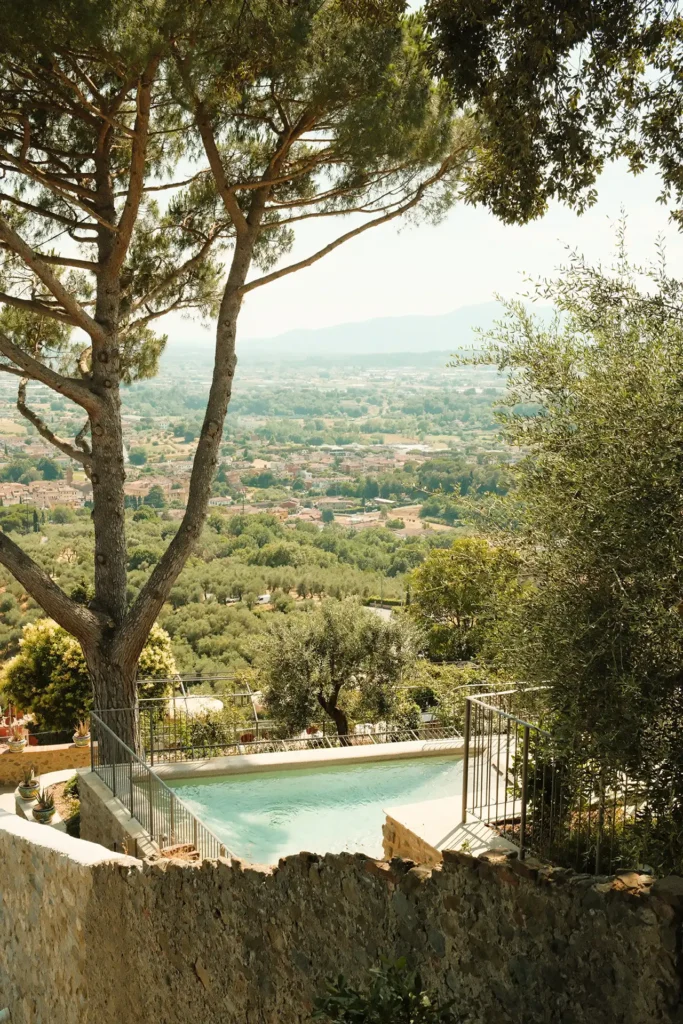
Nestled within the medieval village of Buggiano Castello, overlooking the Valdinievole valley and completely removed from traffic, the resort offers one of today’s rarest luxuries: the silence of nature. The sounds of the city simply do not reach here. Instead, the air is filled only with the wind moving through the trees, birdsong, rustling leaves and the quiet rhythms of the surrounding countryside. Here, the mind can finally release the constant vigilance demanded by urban life.
The gardens, spread across historic terraces overlooking the valley, invite guests to slow down naturally. There is nothing special that needs to be done in order to benefit. Simply sitting quietly, taking in the view or allowing your gaze to follow the contours of the hills is enough. Gradually, the mind regains clarity, focus and that sense of lightness we often fear has been lost.
Many guests describe the experience with a remarkably simple sentence: “You breathe differently here.”
The true meaning of a holiday
Perhaps it is time to rediscover the original meaning of the word holiday.
The Italian vacanza derives from the Latin vacare, meaning to be empty, to be free, to be available. It does not imply escaping reality, but rather creating the mental space in which clarity, creativity and inner calm can emerge once again. Today, this idea is more relevant than ever.
We live in an age of hyperconnectivity, relentless speed and constant performance. The mind needs genuine pauses, not additional stimulation. Silence, therefore, is not a luxury. It is a biological necessity. Places like La Monastica remind us that wellbeing often comes not from adding more to our lives, but from gently taking things away.
Less noise. Less haste. Fewer distractions.
More nature. More time. More presence.
And perhaps this is the most precious expression of contemporary hospitality: offering people an environment where they can rediscover their own natural rhythm. Because reconnecting with ourselves is not an extraordinary event. It is simply what happens when we rediscover how essential greenery, silence and the natural rhythm of time truly are for our mental wellbeing.