History
Immerse yourself in the atmosphere of La Monastica and allow the natural sense of calm and serenity it inspires to envelop you. Listen to the silence, enjoy the privacy, contemplate nature, and admire its history: everything in this Resort is designed to offer you comfort and well-being.
Regenerate in nature and silence
Every room, every space is a place suspended in time: it speaks of the past while the brightness and elegance it radiates project into the future, giving you the opportunity to capture the beauty and truth of the moment, of the now. You can curl up in your room or relax in the gardens, or even visit the Podere with the resort’s vegetable garden or explore the villages, cities of art, thermal baths, and surrounding landscapes: here you will discover the magic of a holiday, a point of departure and return, to discover emotions that you will always carry with you.
La Monastica is the ideal place to reconnect with yourself, recover your balance, and leave behind the stress, tension, and anxiety of daily life. You will fall asleep watching sunsets tinged with every shade of yellow and red and wake up surprised by landscapes that the soft morning light paints like pictures; in the silence of nature, you will rediscover the pleasure of sleeping like a child, while in the SPA you will pamper yourself with paths and treatments designed for your well-being and harmony.
The history of the monastery and its rebirth
The restoration work on the former Monastery of Santa Scolastica, now La Monastica Resort, began in 2005 and involved not only the ancient religious building but also several public spaces and paths within the northern walls of the village. The project started from the idea of restoring that lost integrity not only to the convent but also to the small historic center, recovering as much as possible of the original architectural design and atmosphere.
THE BUGGIANO COMMUNITY COUNCIL DECREES THE CONSTRUCTION OF A WOMEN'S MONASTERY
CONSTRUCTION OF THE MONASTERY
INTERNAL REGISTERS INDICATE THAT A LARGE PART OF THE NUNS AND NOVICES OF THE MONASTERY OF SANTA SCOLASTICA WERE OF HIGH SOCIAL STANDING AND THAT THEIR DOWRIES CONTRIBUTED NOT ONLY TO THE SUPPORT OF EXPENSES BUT ALSO TO THE PURCHASE OF LAND AND OTHER PROPERTIES.
Construction of the well, currently part of the "Paradise of the Soul" path
FIRST EXPANSION OF THE INTERNAL GARDEN WHICH THEN CONTINUED TO ITS CURRENT SIZE
TERRACING AND WORK TO PREPARE THE KITCHEN GARDEN FOR CULTIVATION ARE CARRIED OUT
CONSTRUCTION OF A CONDUIT THAT BRINGS WATER DIRECTLY FROM THE WELL TO THE CONVENT
CONSTRUCTION OF THE STAIRCASE THAT STILL CONNECTS THE NINE TERRACES OF THE GARDEN TODAY
THE CONVENT PASSES UNDER THE JURISDICTION OF THE BENEDICTINE MONKS OF THE NEARBY ABBEY, AFTER WHICH THE MONASTERY IS ABANDONED
THE MONASTERY IS SOLD AT AUCTION AS PART OF A LOT OF OTHER MONASTIC PROPERTIES AND IT'S PURCHASED BY THE MAGNANI FAMILY
THE MONASTERY BECOMES THE SUMMER RESIDENCE OF CANON PELLICCI OF PESCIA CATHEDRAL
THE CONVENT IS ENTRUSTED TO THE FRIARS MINOR OF THE CUSTODY OF SAINT JOSEPH
EXPANSION WORK IS CARRIED OUT AND NEW CELLS AND THE NOVITIATE ARE BUILT
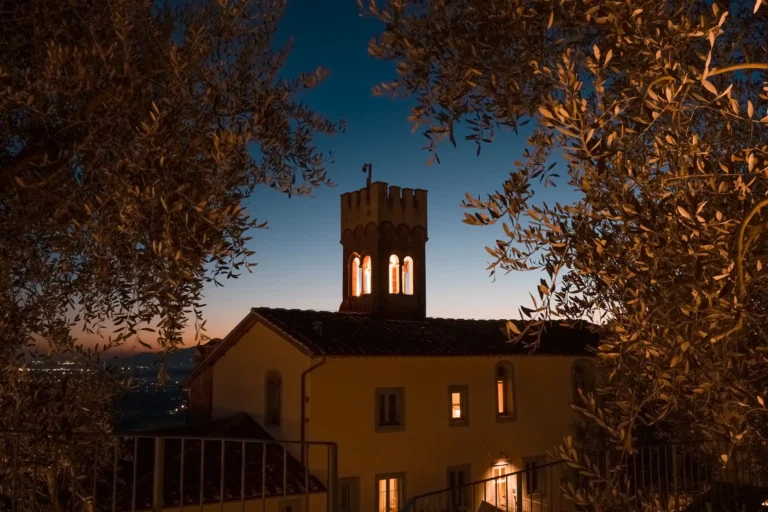
Architect Ferdinando Pacini is commissioned to expand the Church, build the loggia, and create the small tower
The Convent is abandoned by the friars
THE MONASTERY IS ENTRUSTED TO THE BENEDICTINE NUNS OF SANTA GIUSTINA DI LUCCA AND SUBSEQUENTLY ABANDONED
THE MONASTERY REMAINS CLOSED
The ancient road of Buona Cura has also been restored; it runs from the parking area, arriving from the provincial road 29 Colligiana, to reach Piazza Pretorio, and was in a state of total abandonment, invaded by rubble and debris. Without affecting the traces of the past, La Monastica has restored the viability of other paths, created parking areas, rebuilt a large part of the walls, and installed street lighting.
Before starting the work, significant research and documentation were carried out in various Tuscan and national archives. Difficulties were not lacking because over the centuries the walls of civil buildings (the original fortification of the “da Buggiano” family dates back to the 11th century) often intertwined or overlapped with those of religious buildings, and the first available cadastral map is from 1789. Furthermore, since its foundation in the 16th century, the former Monastery has undergone several transformations until the last one in 1907, carried out by the architect Pacini, who expanded the church and built the external loggia.
The restoration intervention was therefore complex and often arduous. It required passion, patience, and many skills. Wherever possible, original elements were restored and used, from the woodwork to the ceilings, and even the decorations were created by recovering ancient colors. Materials were chosen to be as authentic as possible, and specialized craftsmen and artisans were employed, always with the utmost respect for the constraints expressed by the Superintendency of Fine Arts. Today, La Monastica is a Resort that, while maintaining its original spiritual charm, inspires a deep sense of balance and well-being and, thanks to its nature, offers a rejuvenating holiday away from the tensions of daily life.
Breathe the energy of the earth
Seeking to learn more, we conducted research and, according to some measurements, there are two points within the Monastery where the energy flow is particularly intense (intensity is measured with a specific instrument, the Bovis biometer). In these two points, which you will find marked inside the Church and the SPA, the vital energy of the Earth radiates with greater intensity, instilling positive effects on a physical and psychological level. In practice, it would seem that the Earth’s primordial vibrations resonate with our chakras, awakening their energy and helping to counteract the loss of positivity due to an unbalanced lifestyle or stress. To commemorate this deep connection, we have chosen a painting dedicated to the Archangel Michael by the artist Andrea Mattiello for the lobby area.